
2. The First Year Alone
Chapter 2 | by Helen Hinkson Green

Note: This is the next installment of It Takes a Pair, a 34-chapter memoir written by my grandmother, Helen Hinkson Green (1907-2003). It recounts her memories of raising her twin daughters as a single (& widowed) parent throughout the 1940s. It is being published posthumously in her honor, with new chapters released every Sunday. View previous chapters and more information about this memoir.
The first year alone was several centuries long, and a very excruciating inward private hell, no matter how often I counted my blessing. And count them often I did.
Just looking at my two wonderful, beautiful babies could make me feel blessed beyond measure. And there was the job in the high-school/junior high study hall and library assistant combination that fairly fell in my lap. There were the tremendously kind and concerned friends, my very supportive family, sufficient financial income and backlog to alleviate any worry about where the next meal was coming from or to pay for the succession of housekeepers that I was always able to latch onto that first year (five to be exact), and health and stamina enough to stay on top of it all. All these and more were the blessings I gratefully counted and gave thanks for, many times over.
Despite all the good things I had to be thankful for, there were times when I felt so desperately stricken that within that it seemed the awful leaden lump of grief and loneliness would simply swell up and burst, shattering the empty shell of what used to be me. Outwardly, I tried to put on a front, to be pleasant and cheerful enough that I wouldn’t make other folks feel uncomfortable. Or worse yet, have them pity me. I didn’t need pity. I just needed Doug.
But I must not have done too well on the dissembling always. Or else Miss Virginia Gause wouldn’t have run out of her house on a gray November afternoon, ostensibly to peek into the large perambulator to admire my two look-alike babies. I soon found out that peeking at the babies was merely Miss Virginia’s excuse for saying some things to me she thought I needed to hear. She had probably been watching for me, for I had found myself an almost regular route or “beat” along the less hilly portions of the town as I took the babies for an airing in that heavy monstrosity of a buggy that was the only twin perambulator we had been able to find to buy. Finding twin baby buggies isn’t exactly easy in the best of times, and these were war years.
Our babies had been born on the eve of Dunkirk. How well I remember the doctor’s gruffly bawling me out the next morning muttering about this was a hell of a time to bring one baby into the world--let alone two. As if I could have foreseen that it looked as if the British Empire were about to fall on the very night I was fetching forth. Or to have foreseen that consumer goods, especially odd items such as twin baby carriages, just weren’t to be had. But we lucked out on connecting with a used one which somebody who had had twins told us they’d sold to somebody else with twins who had in turn sold it to somebody else, but that they thought it was about ready to be up for sale about now--and here’s a phone number. Thus we had become the owners of what just had to be the biggest, heaviest wicker baby carriage on record.
Afternoons after school, I pushed that huge, heavy buggy along in the gutters at the side of the streets because it was just too hard to maneuver it up and down the curbs at the beginning and end of each block. And I tried to avoid the hills, which wasn’t too easy to do in St. Charles, built on the banks of the Missouri. But if I stayed above Sixth Street, I could find several fairly level streets on which I could handle pushing that heavy pram. My route, thus circumscribed, was so routine that I’m sure folks along the way could probably have set their watches by the exact minute I passed any given point such as Eighth and Madison or Seventh and Clay.
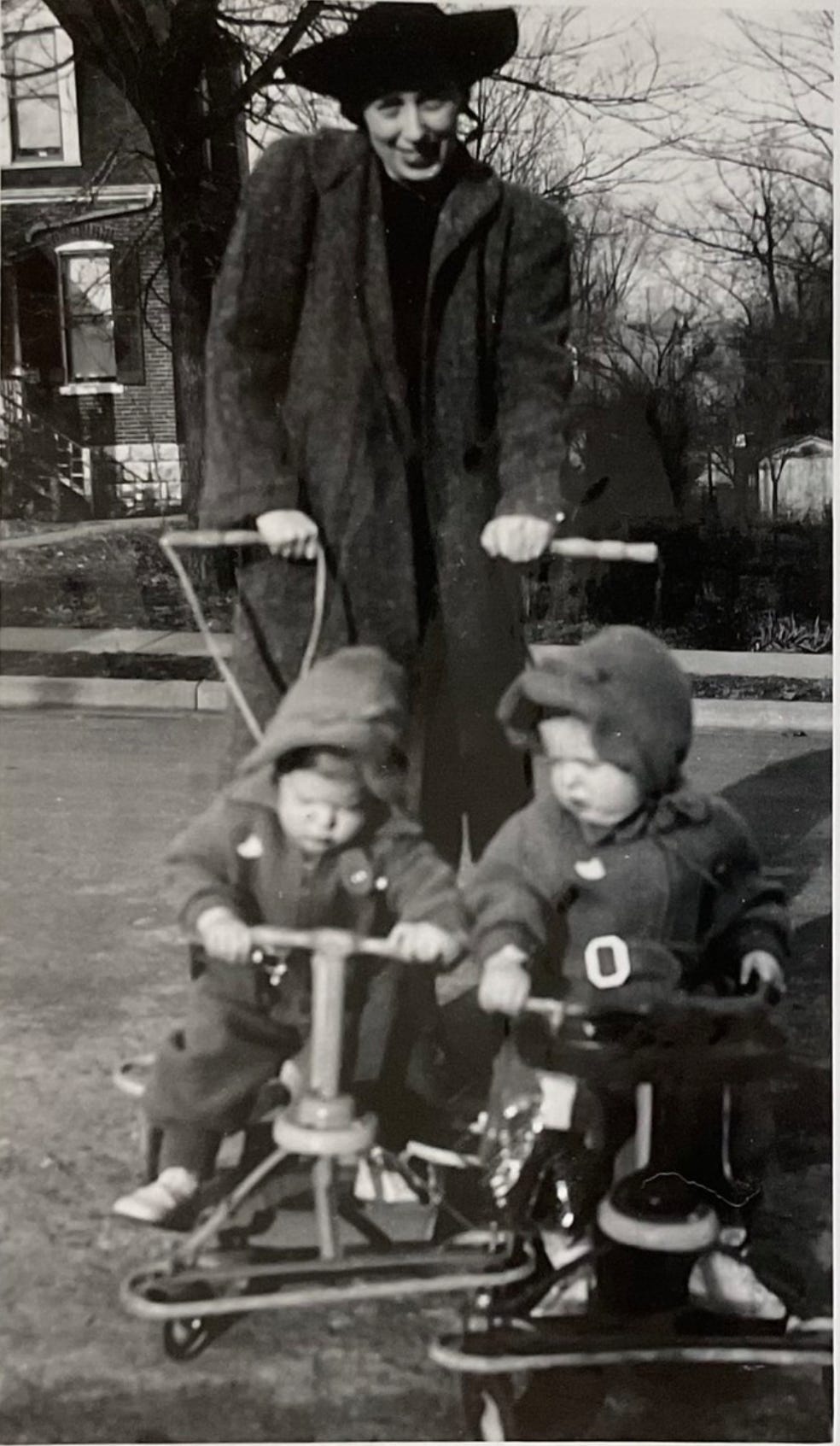
Another bad feature about that buggy was that the hood didn’t reverse making it impossible to see the babies inside. I would have loved to have been able to talk to them as we went along--and at least be sure that I wasn’t spilling them out when I occasionally had to come out of the streetside gutter and negotiate a curb. It was really much nicer when they graduated to scooters, and I could see them as well as push, even though there were times when I couldn’t get the scooters synchronized as to direction and speed. (The scooters, too, were second hand purchases, and one had ballbearingless wheels that didn’t track very well. Wartime consumer goods again.) Nobody seemed to have gotten around to inventing twin scooters as yet back when I needed them.
But on the particular day that Miss Virginia had grabbed up a sweater to throw around her shoulders and come running out to the curb as I passed, we were still in the perambulator stage. And she was wanting to give me a piece of advice, even though she and I didn’t know each other very well. Miss Virginia belonged to one of the established families, whose ancestors were among the founding fathers of the place, I’m sure. And that gave her carte blanche to dispense advice and opinions on whatever and to whomever she chose. And I think she probably chose to do so often--on matters trivial or profound.
For example, I remember that once during the first summer that we lived in St. Charles--the one before the babies came--that Miss Virginia and I were both among the women helping to serve some luncheon at the Sixth Street Presbyterian Church. Miss Virginia had announced to all of us in the kitchen that Mrs. So and So had just brought in two apple pies flavored with cinnamon. If those pies had been laced with arsenic, she couldn’t have been much more horrified.
Said Miss Virginia in a tone that brooked no disputing, “I really couldn’t believe it when I smelled cinnamon on those pies! So I set them aside. We’ll use them at the last if we have to. But can you imagine anyone was ‘knowingly enough to use nutmeg on apple pies!” And such was Miss Virginia’s standing within the community that nobody even laughed, let alone disagreed with her. (Was I ever glad I’d brought cherry pies that particular day.) I had the distinct feeling that the cinnamon, plus the dash of lemon juice I usually used on apple pies, would have relegated me to the ranks of the untouchables in both the culinary and polite society circles as seen through Miss Virginia’s eyes.
On the day that Miss Virginia ran out to peek at the babies, apple pies were not the topic she wanted to talk to me about, and she lost no time in getting right to the point.
“Mrs. Green, why do you always walk along in the gutter?” she asked almost scoldingly. “Why you ought to push that buggy proudly down the street right up on the walk. If you meet anybody, they can just get out of your way or go around.’ Don’t go along in the gutter like that.”
I almost gasped in her face. It had never occurred to me that my pushing the buggy along on the street side of the curb could be interpreted as anything but a way of avoiding having to maneuver that big heavy pram up and down the curbs without spilling out the babies (whom I couldn’t see because of the top) or of wrenching my upper arms and back into a state of disuse. Had Miss Virginia, and possibly others, interpreted my predilection for walking along in the gutters as some sort of self-abasement, of outward expression of withdrawal or lowness of spirit? Whatever it was that she was trying to tell me couldn’t have any direct connection with my motive for pushing the big buggy along in the gutter.
“Miss Gauss” I blurted out, “I push this huge heavy buggy along in the gutter because I simply can’t get it up and down the curbs without great difficulty. This big double wicker, heavily padded carriage just doesn’t handle as easily as those little single canvas jobs that most girls with just one baby manage so easily. It’s the same reason why I walk just about the same route every evening. I try to avoid the streets with hills. Believe me, we would have bought a smaller, lighter twin carriage if there’d been any to be had. We were lucky to find this huge one secondhand. But it’s the reason I walk along in the gutters.”
“Oh, I know about that buggy,” she said. “I recognized it right off. I remember when the McElheiney twins had it brand new. That grandmother was so proud of those twins that she bought them the largest, fanciest buggy on the market. Even had it shipped over from London, somebody said. It got passed around for several sets of twins before it landed over in St. Louis County, I hear. But it wasn’t any trouble for a big man like your husband to handle, was it?”
“No,” I said quietly, “lots of things weren’t any trouble for him.”
Miss Virginia must have caught something she didn’t like in my tone, for she said quickly, “Let me tell you something, Mrs. Green. And don’t you forget it. Don’t ever let yourself feel sorry for yourself. Not ever! You’ve had more than lots of women ever have. I never had a husband--or two beautiful babies like yours. And lots of married women never have such fine husbands or such beautiful babies, either, even though they’re married. Some women have crippled, or blind, or mentally slow babies. And there are others who have husbands that neglect or abuse them, or can’t even support them even though they try. Oh, don’t think those good German neighbors over there around where you live haven’t spread it around town about how that ‘nice young man‘--that’s what they called him--put out that huge diaper wash every morning before he went to work. Believe me they were impressed. ‘She’ll really miss him‘ is what the one who lives in that little red brick house catercorner across the street from you said to me. And she went on to say, ‘That man was good to that little woman. He helped her take care of those two babies. Not many men would do all he did to help her. He was a fine man.’ And I agreed with her,” Miss Virginia said, pausing for breath.
“I’ll tell you about that diaper wash,” I replied with a smile. “When my mother was ready to go home after having helped us through those first eleven weeks of three-month colic--which the doctors called pyloric spasms-- Doug said to her, ‘I don’t think we’d have made it through all the colicky nights if you hadn’t been here to help. Now tell me what I can do that will be the most help in taking care of these babies. I’ll certainly do it.’ And my mother had replied, ‘I’ve thought about that, and I believe the greatest help would be for you to take over the daily baby wash. I’ve been doing it, and it isn’t hard--just time consuming. You could get up a little early and do it before you go to work. I’ll show you how I do it if you wish.’ And she did--and he took over the diaper detail. He’d have that wash out on the line before he showered and shaved.”
“And that’s when your neighbors would see him out hanging up that wash,” Miss Virginia said. “And they really admired him for helping out.”
“I don’t know how I’d have managed everything if he hadn’t helped,” I said. “We inquired around, and there is such a thing as diaper service in St. Louis, but they wouldn’t extend their route clear out here. And the doctor didn’t think the disposable ones are very good to use yet, except occasionally, like when you’re on a trip. So Doug took over the washing chores. We just shoved the whole daily schedule up an hour. Instead of six a.m. bottles, we started the day at 5 a.m. When the alarm went off, I headed for the bottles and the bottle warmers, and he picked up the diaper pail and headed for the basement. On bad days he hung the wash in the basement, but things bleached out nicer and dried faster outside usually. He was always saying that some day someone would invent home dryers and then folks would have it made.”
“They probably will,” said Miss Virginia, “but you’ll be through with diapers before they do. Or at least before they’re in common use.” Then she drew her sweater around her a bit closer and added, “Well, I mustn’t keep you or stand out here any longer in the cold myself. It’s quite chilly. But just remember what I’ve told you. Never feel sorry for yourself. You’ve had a lot. And you’ve still got a lot with those two beautiful babies. And you’re still young,” she added knowingly.
“I don’t feel sorry for myself, Miss Gauss,” I said. “But thank you for coming out to talk. And if anybody asks you why I push the babies along in the gutter, you tell them, please. And I’ll remember all the things you said if I’m ever tempted to stop counting my blessings.”
And Miss Virginia ran back into the house, and along the gutter we went--my two beautiful babies and I.
No, I don’t think I ever felt sorry for myself. I knew without Miss Virginia Gauss’ telling me that I was blessed among women in so many ways. But the knowing didn’t do away with the awful, overpowering at times, aching longing and loneliness that made everything I did and said seem somehow unreal--as if someone else were executing both the doing and the saying. Somebody who was walking around, masquerading as me. And apparently getting away with it at least part of the time. But there were a few discerning and perceptive individuals such as Miss Virginia Gause who suspected differently apparently. Or who didn’t understand that the feelings of desolateness and sadness do not necessarily equate with feeling sorry for oneself. What they equate to is, or was, in my case, missing my husband in every way that it is possible for a woman to miss her man.
Wow, your grandmother is a great writer! Brilliantly drawn character of Ms. Gauss, and such a heartfelt memory of your grandfather. I am looking forward to more.
That is truly fascinating writing. Thank you for sharing!