
4. The Child Michael
Chapter 4 | By Helen Hinkson Green

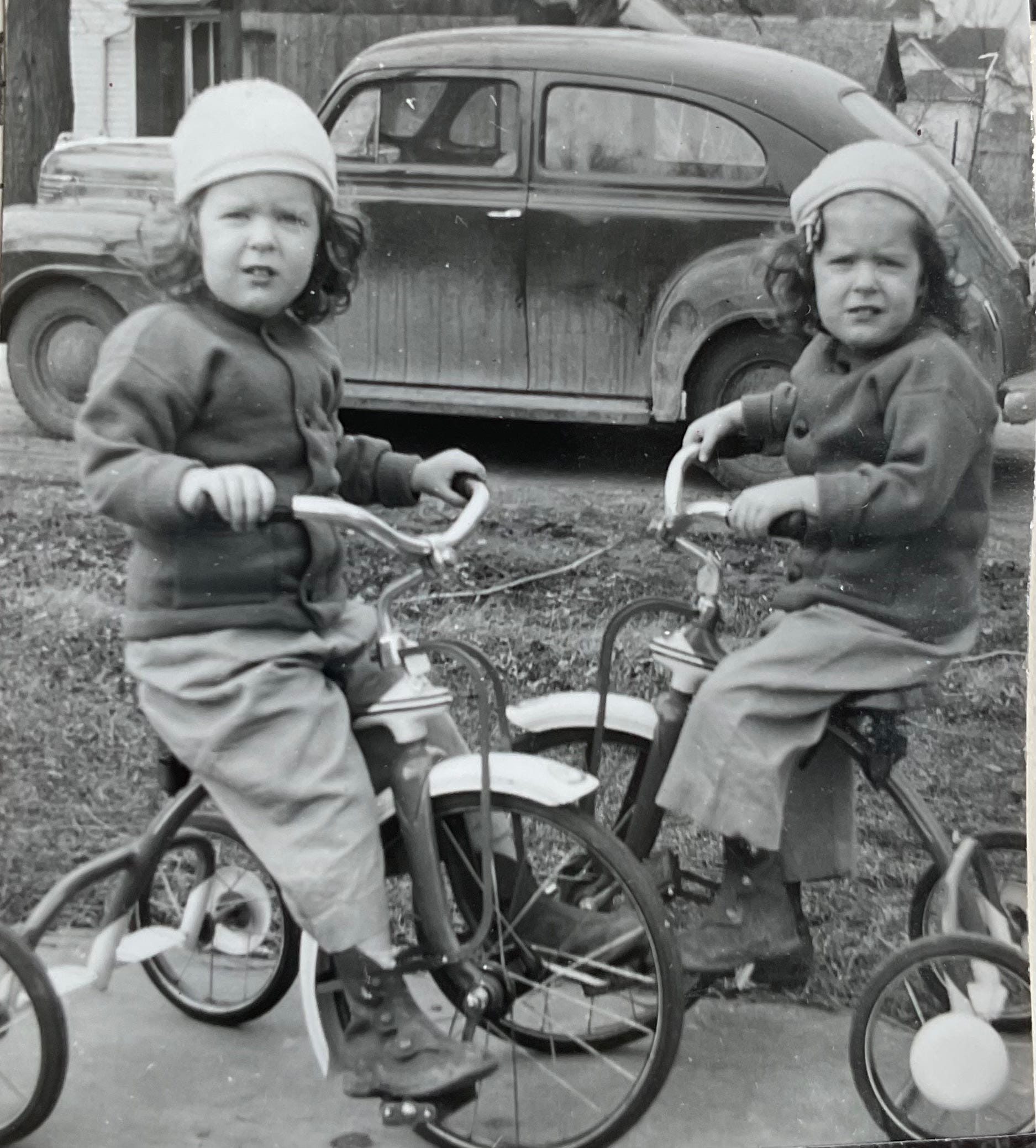
Note: This is the next installment of It Takes a Pair, a 34-chapter memoir written by my grandmother, Helen Hinkson Green (1907-2003). It recounts her memories of raising her twin daughters as a single (& widowed) parent throughout the 1940s. It is being published posthumously in her honor, with new chapters released every Sunday. View previous chapters and more information about this memoir.
Michael was the child who came to live with us, suddenly and quietly, but persistently and continuously for almost a year. The child’s coming was unexpected and unannounced. I doubt if Michael himself had any idea that he would stay so long. I feel equally sure that he had no warning of his departure. Nor did we.
But the sudden exodus of Michael from our midst left me feeling a bereavement that was disturbing, rather than desolate, in its effect. For it was ridiculous to feel anything but relief that Michael was gone, my common sense kept saying. And common sense was certainly right. Unfortunately, or fortunately, depending upon the circumstances and how you look at them, common sense is not necessarily the regulator of human emotions. Michael’s going left a decided sense of something missing and wrong overshadowing my days--a feeling of loss for something I really had never possessed that neither reason nor my determined effort to laugh at my feeling could quite dispel. I would have been most embarrassed if anyone had suspicioned how strange, deep down inside of me, Michael’s sudden withdrawal had left me feeling.
For there was nothing--absolutely nothing to be bereaved about. Actually, I should have been relieved and even delighted that the problem which Michael had power to create had been so simply removed and avoided. And in truth I was. Still, there persisted for days that odd sense of loneliness--such as the sense of loss one feels when the child down the street, whom one has watched playing and to whom one has waved in passing, moves away. Most assuredly the world is made a finer place in which to live and be because there are friendly children about us. And Michael was a friendly child. A surprisingly tractable one, too, compared to my own two in many ways. His tractableness had made him an agreeable house guest--if guest he was. Probably member of the family would be a more apt descriptor of his status in our household. Yes, decidedly more apt. And it was the feeling that I had lost a child that was the disturbing part of his going.
Michael had entered our family circle one night at the supper table in early spring. The “circle“ that particular spring consisted of Lula, a sweet-tempered, calm, cheerful redheaded young woman, somewhere around thirty as to age, for whom the term housekeeper was ridiculously inadequate, so beautifully, lovingly, and efficiently did she care for my not-yet-three twin daughters and, in a way, me. A me who was still not really believing I wouldn’t some day wake up to find the past two years of widowhood and my return to teaching all an unreal dream. But that has nothing to do with the story of Michael except to set the stage for his coming.
Supper, except on rare occasions that year, was eaten in the kitchen. Lula and I faced each other across a small kitchen table, each flanked by a twin in a high chair. Lula indulgently wiped up the spilled milk and bites that “missed“ on her side of the table with a motherly patience and calm matter-of-fact acceptance of responsibility for her child that would have made a casual observer had there been one wonder who really was the parent in the group and who was the employee. In fact, pitting the children’s goldenly red hair and Lula’s slightly darker against my own merely reddish locks would have stacked the odds in her favor as being the mother.
Came a moment of great dawdling on the part of Jennifer--Lula’s charge for that particular night. “Eat your applesauce, Jennifer,“ admonished Lula. “It’s so good.”
Apparently in an amiable mood at the moment, Jennifer obligingly lifted a spoonful of applesauce mouthward, then hesitated. She looked at Lula with a somewhat quizzical look as if Lula had said something that didn’t quite get through to her. Then she announced rather emphatically, “I’m Michael.” Whether she was deciding that Michael wouldn’t have to eat applesauce, I’ve never known, but Lula, a genius at getting along with the children didn’t question it or argue. “Then, Michael, eat your applesauce. It’s very good.”
The applesauce laden spoon promptly proceeded on its journey to Jennifer’s waiting mouth and was popped in with an amazingly small amount of spillage.
Meanwhile Penelope (we were still saying “Penelope“ much of the time in those early years) had paused in wide-eyed fascination at the mention of Michael and at Lula’s ready acceptance of the new game. And you could see by the twinkle in her eyes that game she considered it. Almost as if she had prearranged the ground rules with Jennifer, she announced gaily, “I’m Dixie. A bang of her spoon on her highchair tray emphasized the point. “And I don’t want my applesauce.” (If Jennifer was getting attention over applesauce, she could, too.)
“But Dixie does,” said Lula with ready acceptance of whatever was going on. And it is very, very good.”
Such ready acceptance of Dixie along with Michael sent both girls into gales of laughter. Supper ended in a riot of hilarious merriment and countless repetitions of “I’m Michael,” and “I’m Dixie,” with each repetition of the new names bringing forth squeals of delight and peals of laughter--albeit much downed applesauce between the shouting and giggling.
It was as if they had found a new toy to take apart and examine. At bedtime they were still enjoying their new names. “Dixie has Michael’s teddybear,” Jennifer would say. “Give it back to Michael.” “No, it’s Dixie’s Teddy bear,” Pennywould say. “Dixie’s has the pink ribbon.” Having straightened out the teddybears (which were the sleep toys) and added a codicil to the nightly prayers at their insistence of “Bless Michael and Bless Dixie,” Lula and I closed the bedroom door gently and grinned to each other in grown-up fashion in appreciation of the dearness of children. And thought no more about it.
At least not then.
Even the fact that Michael and Dixie were still with us the next morning gave us no hint that Michael had come to stay--at least not for so long a time. It was a new game, and fun, the children seemed to think. And Lula and I, knowing something about the attention and interest spans of not-yet-three-yearolds, thought very little about it.
The source of the names Michael and Dixie was certainly no mystery. We could deduce that instantly. Michael, or Mike, was the seventh-grade boy who delivered the paper to our back porch each evening. He lived over on the next street about a block and a half down toward town; and Dixie was the five-yearold who lived next door to Michael. The association was plain.
Everytime the children walked to town with Lula, they passed Michael’s and Dixie’s houses; and frequently, Dixie, an extremely self-sufficient child, was out on her tricycle as they passed. Usually she eyed them with a mixture of curiosity at there being two of them just alike and with the superior disdain of a big five-year-old for the not-yet-three ones. And openly the children were entranced at her “bigness“: for five is certainly big to those not yet three.
Undoubtedly when Jennifer suddenly chose to be Michael, Penelope immediately thought of Dixie who lived next door to Michael and assumed her name. And though Lula remarked after a few days of having Michael and Dixie inhabiting our household that it was odd that Jennifer should have chosen a boy’s name for her new entity, it really was not.
For of all the inhabitants of Jennifer’s small world, Michael was by all odds, the most engaging, the friendliest, and yes, the most beautiful--though I’m sure Michael would have been outraged if he had known anyone had thought of applying that last adjective to him even covertly. In addition, Michael was slow-moving and easy-going, two qualities which must have subconsciously appealed to Jennifer who was physically a shade slower than will-o-the-wisp Penelope. As a consequence, Jennifer was forever being hurried through life both by her own impulse to keep up physically and by the external forces which seemed to expect twins to move about alike. Furthermore, Michael had an endearing way of always taking time to talk to the twins in his slow, sweet way whenever he delivered the paper. And while any boy would balk at being called beautiful, there was no denying that Michael was clearly that. He possessed high cheek bones, firmly chiseled features, and curly lips that could have been beautifully sculpted, smooth rosy brown skin, even white teeth, and eyes so shiny clear that you were never sure whether they were tawny brown or tawny hazel. Top that all off with smooth brown hair and a dear, slow smile and you had Michael. Small wonder that Jennifer who responded to beautiful things so sensitively decided to be Michael if she chose to play at make-believe identity.
Actually, I don’t think Michael’s maleness was ever a part of the assumed identity, for from the moment Jennifer opened her eyes, she was, and still is, feminine, in all the fine and nice senses of the word. Put a tiny ribbon in her hair, a string of wooden beads around her neck, though she might be wearing nothing else at the time but a diaper, and she fairly preened. She knew she was pretty with such accoutrements, and her delight in the knowledge showed. I think she just assumed all those wonderful unisexed qualities that Michael possessed that were appealing. Oddly enough, I was the one who somehow though it all came to feel that I had this shadowy third child--a boy--child to care for and love. For I never for one single instance relinquished Jennifer for Michael. No way! As far as I was concerned, Michael, if he were going to hang around simply had to find his own place, for never, never was he going to replace Jennifer. At least those were my unexpressed thoughts. And, of course, it was all just a game.
Only to Jennifer the game was more than just casual make believe apparently as time went on--in fact we became increasingly aware of. Dixie went the way of many imaginary companions or personalities that children dress up after a comparatively short period of time. And she never superseded Penelope completely in Penelope’s own mind. “I’m Dixie“ became a less frequent rejoinder as spring edged over into summer. Perhaps Dixie wouldn’t have hung around as long as she did if Penelope hadn’t felt a necessity to play the game along with Jennifer. And almost from the first, she had refused to accept anyone else’s identifying her as Dixie. “I’m Dixie,” she might shout joyously and mischievously upon occasion; but let anyone else say something like, “Here, Dixie, is that ball you were hunting,” and she would instantly say, “I’m Penny,” in an uneasy sort of way. It was almost as if she felt the game were getting out of hand and she wanted to bring things back under control before it was too late.
But not so with Jennifer. Patiently and persistently she educated us to Michael’s presence in the household. “Come in and wash for lunch, Jennifer, please!“ would bring a “Michael will come,” response. And Michael always came more readily than Jennifer ever had, for she was never ready to leave whatever she was doing. Or at lunch time, “Would you like more milk, Jennifer?“ brought a “Michael would like more milk, please.” After the first few days, the “this is a merry game“ attitude disappeared. There was no more giggling and no teasing in the tone. It was as if she had to remind us--since we were somehow too stupid to remember just who she was. Strangely enough, there was never any petulance or irritation about the matter, merely a quiet insistence of a correction she must make.
For some reason, perhaps one that would be hard to explain, we adults of the household had a tacit agreement to try never to address Jennifer as Michael. It could have been merely that we were obtuse grown ups who wouldn’t be hoodwinked into prolonged playing of a child’s make-believe game. But I’m more inclined to believe that it was more truly that the game made us uneasy--we didn’t want to lose Jennifer, though we never said anything that foolish aloud. Hence, Jennifer’s need to remind us innumerable times daily about Michael’s presence since the adults were either ignoring him or forgetting about him. Could it have been that by some unwritten, unspoken, even unagreed-upon pact we adults were decreeing that we would ignore Michael and maybe he would go away?
Ignoring Michael’s presence wasn’t all that easy. And go away, he certainly did not. “Michael’s“ dropped from Jennifer’slips as effortlessly and profusely as crumbs from a highchair. As I worked in the kitchen or yard now that school was out, I would hear snatches of small-children talk from the sand box under the mulberry trees. “Michael is making a tunnel--a big tunnel.” “That is Michael’s spade. Give it back!“ But listen as I might, I could never hear any pronoun signifying gender attached to Michael. The pronouns always referred to Jennifer--or Jennifer’s self. For Jennifer was Michael. Or was it beginning to be vice versa.
By now, Mother had come home for the summer (after all, it was her home which she had kindly lent us) and Lula had gone home for the summer as well. But again, Mother and I never discussed the Michael situation. We just ignored when we could and accepted silently when we couldn’t. But in spite of the fact that we tried to give very little attention to Michael, it wasn’t long before various people up and down the street and about the small town knew about Michael. But they had trouble identifying him.
Jeanette McCracken, the wife of the doctor who lived down the street on the corner, cut across Athea Carroll’s back yard one morning to announce with a grin, “Michael is down at our back porch playing with Doc’s kittens--in case you miss anyone. I don’t know which it is. I can’t tell them apart even when they go by their right names.“
“It’s Jennifer,” I said, and went back to her corral Jennifer. Not Michael.
“Jennifer, my sweet one,” I said as Jeanette and I arrived at the back steps, “you mustn’t go down to Jeanette’s without first asking permission. Don’t you remember we have a rule that nobody ever leaves the yard without first asking permission to go?“
“But the kitty came up to our house first,” replied Jennifer matter of factly. “So Michael brought it home.” The look in her eyes suggested that even an unfathomable adult could not find Jennifer guilty of any infringement of the rule since it was Michael who had been involved. (There are times when it’s convenient to have an alter ego.) Jeanette gave me an amused glance and hid her smile by disappearing into her own door, while Jennifer and I--or was it Michael and I--went home.
It couldn’t have been more than a week later that Mildred Cullen who lived across the street down on the corner from Jeanette came across the street to see us in the middle of the morning. “I can’t stay,” she said, “**but I have a guest. Or rather, Harry’s toy shelf has a guest. Now don’t scold her, because she stood on your side of the street and watched me hanging out clothes. I really started it because I stopped and called out to her, ‘Which one are you?’ And she said, ‘Michael.’ Can Michael come over and play with Harry’s toys?’ So I helped her across the street and took her into Harry’s room and she’s having a ball in there--chattering away to herself about Michael this and Michael that. Harry’sover on the next street playing Superman, so he’ll never know what hit his toy shelf. But Michael will.” Then she gave an odd little laugh. “Which one is it that calls herself Michael? It’s funny--but it sort of gives me the creeps. I can’t keep them straight when they go by their right names.”
And I went back across the street with her to bring Jennifer--or was it Michael--home.
(to be continued)
» Look for the release of a new chapter of It Takes a Pair next Sunday.